Hair Porosity Explained (And Why Yours Might Have Changed)
For a long time, I confidently labeled my hair as low porosity.
I didn’t guess, I used the strand (float) test. I followed the rules. And for a while, the label seemed to fit. But recently, while doing my hair and paying closer attention to how it actually reacts to water and products, something stopped adding up.
My hair wasn’t behaving the way “low porosity hair” is supposed to behave anymore.
I haven’t redone a strand test yet, but I didn’t need to. Real-world behavior told a different story. And looking back, postpartum changes likely played a bigger role than I realized at the time.
This article breaks down what hair porosity really is, why common tests can be misleading, and how life stages (like postpartum) can shift how your hair behaves over time.
What Is Hair Porosity?
Hair porosity refers to how open or closed your hair cuticle is, which affects how easily your hair:
- Absorbs water
- Holds onto moisture
- Responds to products
- Reacts to humidity
Porosity is not the same as curl type.
You can have:
- Loose waves or tight coils
- Fine or coarse strands
- And still fall into any porosity category
Porosity is about structure and behavior, not appearance.
To learn more about curl patterns specifically, I break down hair types from Type 2 to Type 5 in my Curly Hair Resource Guide.
The Three Types of Hair Porosity (Quick Overview)
Low Porosity Hair
- Cuticles are tightly closed
- Water beads up or sits on the hair
- Products often feel like they just sit on top
- Heat or steam is often recommended to help absorption
Medium Porosity Hair
- Cuticles are slightly raised
- Hair absorbs water easily but not instantly
- Products penetrate without much effort
- Moisture balance is easier to maintain
High Porosity Hair
- Cuticles are very open or damaged
- Hair absorbs water fast but loses it just as quickly
- Frizz appears easily
- Layering and sealing are usually necessary
Most people actually fall into the medium porosity range, even if they’ve been told otherwise.
Why the Strand (Float) Test Can Be Misleading
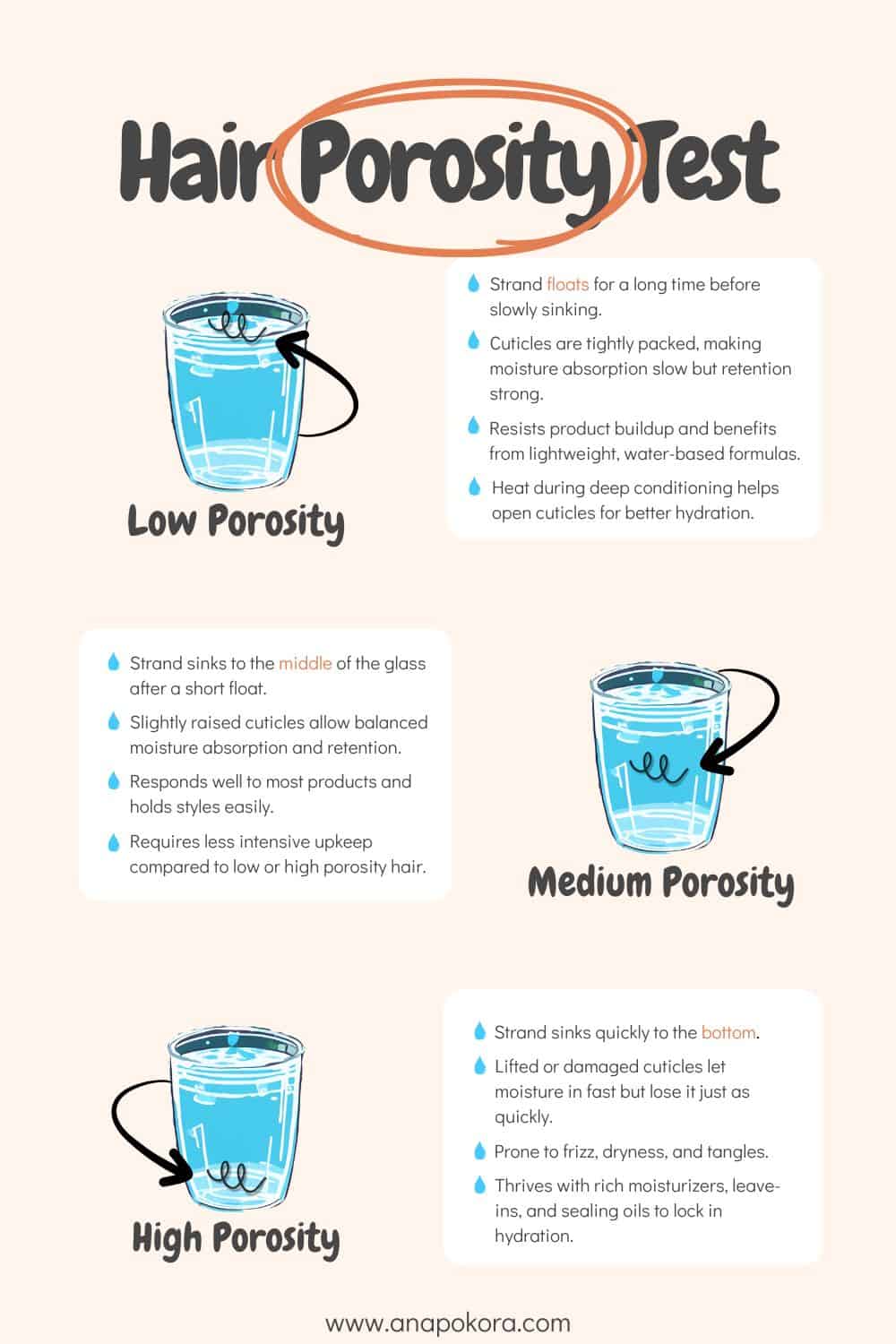
The strand (float) test can be a helpful starting point, but it shouldn’t be the only thing you rely on when determining hair porosity.
Results can be affected by product buildup, hard water, hair age, water temperature, and the fact that one strand doesn’t represent your entire head. Because of that, the test can point you in a general direction, but it isn’t always definitive.
When you go to a salon, a stylist doesn’t do a strand test. They observe how your hair absorbs water during the wash, how it responds to products, and how it behaves over time. That kind of observation matters, and it’s something you should do at home too.
I originally identified my hair as low porosity using the strand test during postpartum. Looking back, I trusted the test more than how my hair was actually behaving and that’s where things stopped lining up.
How Postpartum Hair Can Change Porosity
Postpartum hair is different even when it looks “normal.”
Hormonal shifts after pregnancy can affect:
- Oil production
- Cuticle behavior
- Elasticity
- Moisture retention
Add in:
- New growth
- Regrowth around the hairline and part
- Environmental exposure
- Time since a big chop or major cut
…and it becomes easy to misclassify your porosity.
What looks like low porosity postpartum can sometimes be temporary dryness, buildup, or hormonal imbalance, not a permanently sealed cuticle.
Seasonal changes can also affect how your hair absorbs moisture and responds to products. I break this down further in my guide on how weather and seasons impact curly hair routines.
Can Hair Porosity Change? What I Noticed
I didn’t need a test to notice the change; I saw it during styling.
Over the past year, I’ve been consistent about restoring my hair from hard water and postpartum damage. That meant clarifying when needed, steaming my hair, and rotating deep conditioners so my hair could get moisture, strength, and balance, rather than relying on a single treatment.
As a result, my hair started responding differently. Here’s what stood out:
- Water no longer beads and sits on my hair
- Spray absorbs more evenly instead of resisting
- Frizz appears quickly at the surface when damp
- Lightweight products work better than heavy creams
- I no longer need heat or steam to get absorption
Those aren’t classic low-porosity behaviors. They’re signs of hair that accepts moisture, reacts at the cuticle level, and doesn’t need forcing, which points much more toward medium porosity.
I’ve shared more details about how I rotate treatments and choose conditioners in my deep conditioning guide.
How to Reevaluate Your Hair Porosity (Without Overthinking It)
You don’t need a bowl of water or a microscope.
Instead, pay attention to:
- How your hair reacts when sprayed with water
- How long it takes to fully dry
- Whether products absorb or just coat
- How your hair feels over the next 24–48 hours
Hair porosity isn’t a one-time label. It’s something that can shift with:
- Hormones
- Environment
- Hair age
- Routine changes
Reevaluating your porosity every few months is normal, especially after big life changes like pregnancy.
FAQs About Hair Porosity
Can hair porosity change over time?
Yes. Hair porosity can change due to factors such as hormonal shifts (including postpartum changes), environmental exposure, hard water, heat, chemical services, and inconsistent hair care. Porosity isn’t permanent, and it’s normal for hair to behave differently over time.
Is the strand (float) test accurate for determining hair porosity?
The strand test can be a helpful starting point, but it isn’t always reliable on its own. Product buildup, hard water residue, hair age, and water temperature can all affect results. Observing how your hair absorbs water, responds to products, and behaves during wash and styling days often gives a clearer picture.
What are the signs of medium porosity hair?
Medium porosity hair typically absorbs water easily without excessive beading or instant saturation, holds moisture relatively well, and responds best to balanced routines. Lightweight products tend to work better than heavy creams, and the hair doesn’t require heat or steam just to absorb moisture.
Final Thoughts
Hair porosity is a tool, not a personality trait.
Tests can help, but they don’t override observation. If your routine stops making sense, that’s usually a sign your hair has changed, not that you’re doing something wrong.
For me, postpartum hair and time shifted how my hair behaves. Recognizing that allowed me to adjust instead of forcing routines that no longer fit.
Listening to your hair will always matter more than sticking to a label you chose years ago.
Let’s Make Inbox Magic
Join my circle to unlock the Curly Mama Freebie Library, your all-access pass to printables, checklists, and resources made for busy moms and curly hair lovers.
Already subscribed? Click here to access the Freebie Library.

One Comment